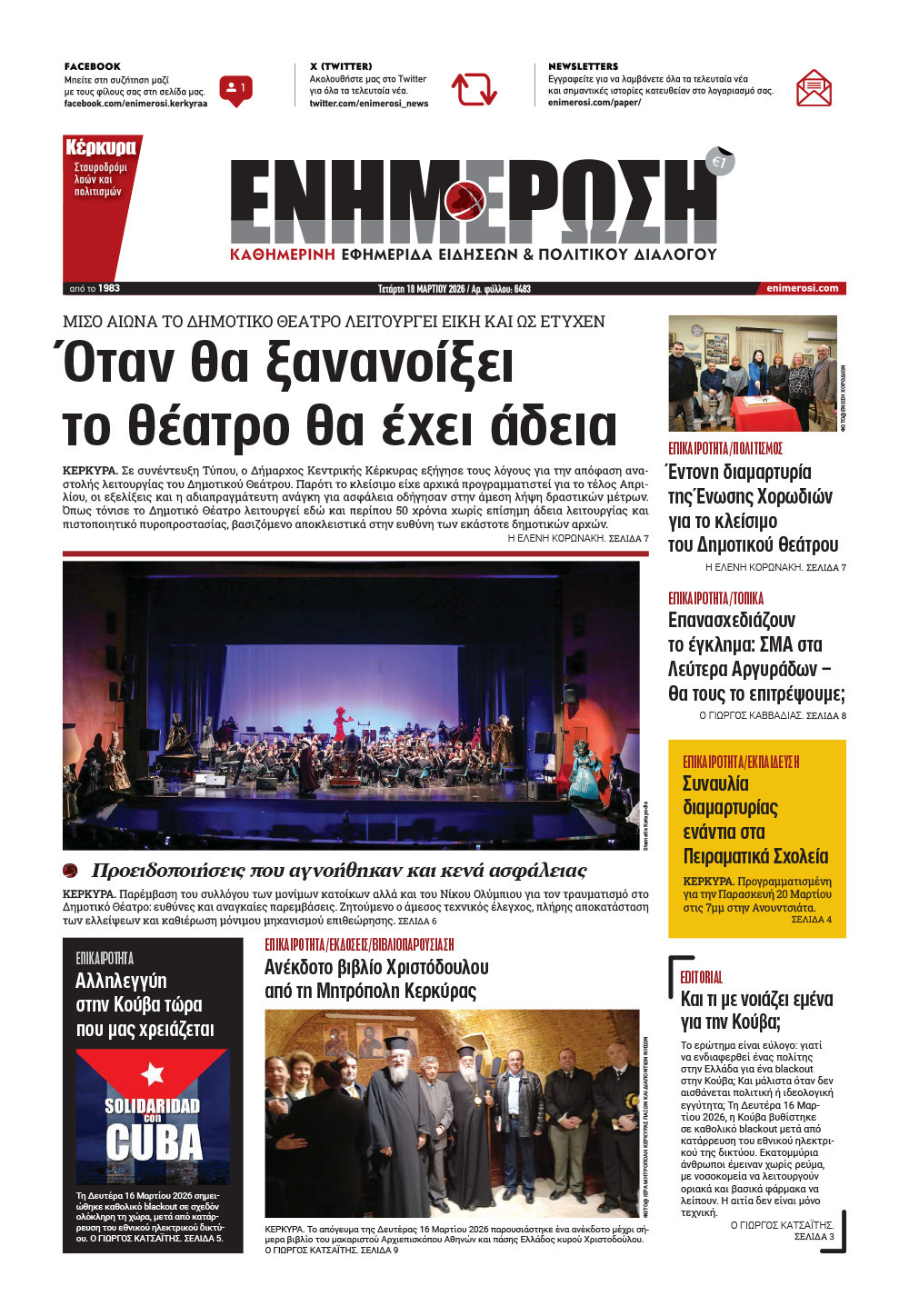
When a town loses its theatre stage

In the early 20th century, Corfu had two to three times as many theatre stages per capita as the capital.
If one traces Corfu’s trajectory through a simple indicator—the ratio of theatre stages to population—the transformation of the town’s character becomes strikingly clear. Around 1900, Corfu had a population of roughly 25,000–30,000 and supported a theatrical life unusually dense for its size. The historic Teatro di San Giacomo served as the centre of opera and theatre until 1902, when it was replaced by the new Municipal Theatre, one of the most important opera houses of its time. At the same time, smaller stages operated in the halls of cultural associations and philharmonic societies, such as the Reading Society and the Old Philharmonic. In total, one could identify four to six active performance venues. In other words, there was roughly one theatre stage for every five to seven thousand residents.
During the same period, Athens had a larger population—around 130,000–150,000—and approximately six to ten theatres, including the Royal Theatre and the Municipal Theatre of Athens. There, the ratio was roughly one stage per fifteen to twenty thousand residents. In other words, Corfu had two to three times the density of theatre stages compared to the capital.
This comparison is not merely numerical. It reflects a society that had integrated theatre, music, and public artistic expression into its everyday life.
Today, Corfu’s population stands at around 100,000. The town’s main stage, the Municipal Theatre, has been closed indefinitely for repairs following an accident linked to operational failures. At the same time, the historic Phoenix cinema-theatre has remained closed since 2006. In effect, the town is left without a functioning theatre stage (with the exception of the Ionian Academy).
The comparison reveals something deeper than a simple lack of infrastructure. Over the course of a century, Corfu has shifted from a town with an exceptionally high density of theatre stages to one deprived of its most basic cultural infrastructure. This is not merely a technical issue; it is a symptom of a broader change in the town’s cultural identity.
GIORGOS KATSAITIS