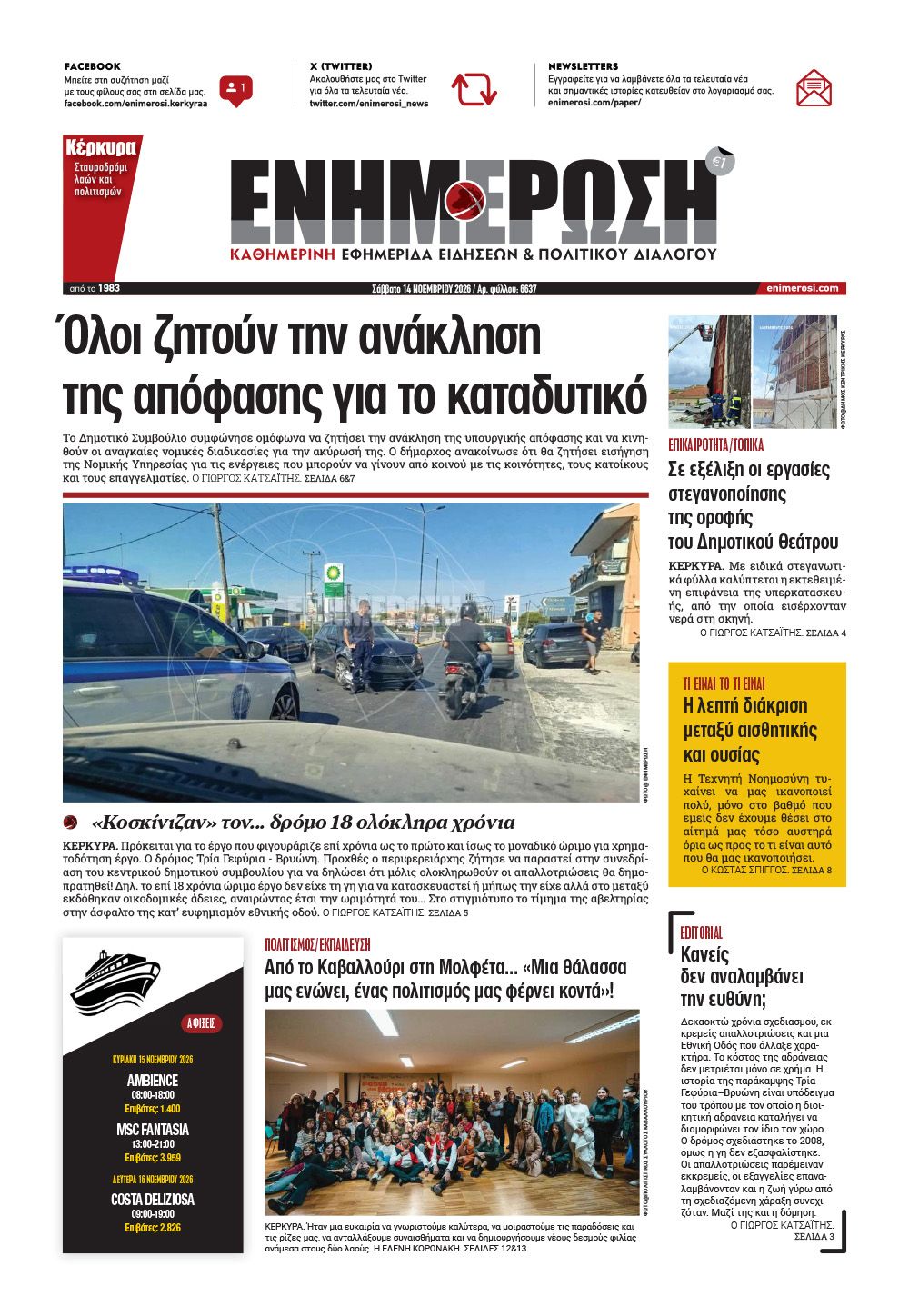
Who is taking responsibility?

The Tria Gefyria–Vryoni road project remains on paper, the compulsory land acquisitions were left pending, and construction continued, forcing the authorities to change the route. Meanwhile, the National Road underwent a transformation, with consequences for traffic and raising questions about road safety and the protection of the lagoon. Who is being held accountable for the cost of eighteen years of inaction?
Eighteen years of planning, outstanding compulsory land acquisitions and a National Road that has changed character. The cost of inaction cannot be measured in money alone.
The story of the Tria Gefyria–Vryoni bypass is a textbook example of how administrative inaction ends up shaping the very landscape itself. The road was planned in 2008, but the land was never secured. Compulsory acquisitions remained pending, announcements were repeatedly made, and life around the planned route went on. So did construction.
Eighteen years later, the regional governor explains that the route had to be changed to avoid affecting homes built in the intervening years. This admission is revealing. Instead of public planning establishing the conditions for an area's development in good time, it is being adjusted retrospectively to accommodate faits accomplis.
And the issue is not limited to the properties lying in the path of the future road. Eth.Lefkimmis Road is gradually being transformed into a commercial and residential corridor, with entrances, exits and intersecting traffic movements. Road safety is taking a back seat to the needs of roadside businesses and properties. Any link to specific road accidents requires evidence, but there is no need for further proof to recognise that this combination creates risks.
And then there is the lagoon, just nearby. An already burdened wetland, alongside which new engineering solutions are being sought. It remains unclear whether the changes to the route will result in additional environmental pressure.
The issue goes beyond the question of whether each building complies with planning regulations. Even permits that are entirely legal can collectively produce a problematic outcome when coherent public planning is absent.
Who protected the land earmarked for the project? Who assessed the cumulative impact of roadside development? And who is now accounting for the cost of the delay?
Putting the project out to tender in 2027 does not answer these questions. Because the real shortcoming is not simply a road that was never built. It is public planning that gave way to faits accomplis.
GIORGOS KATSAITIS