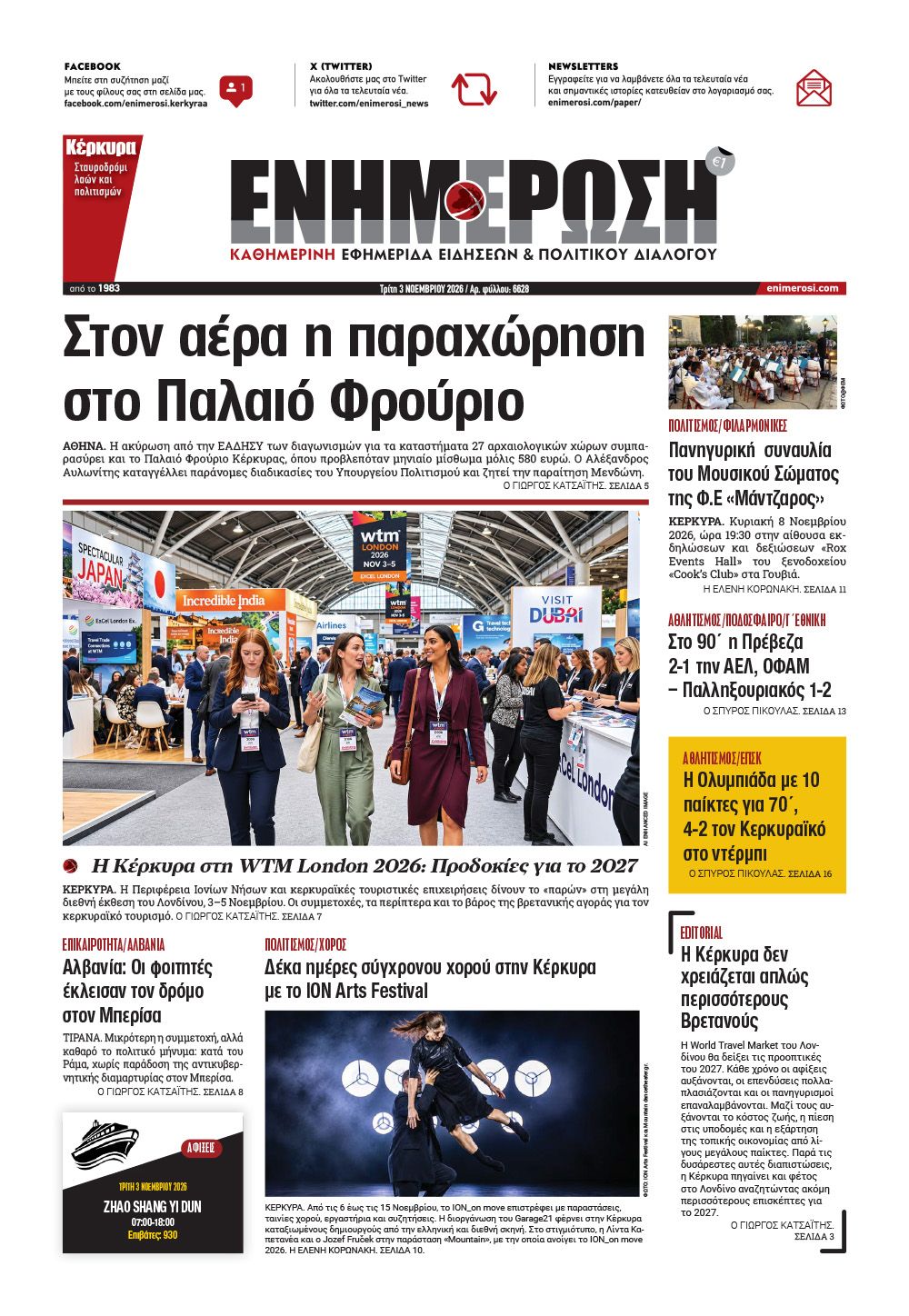
Corfu doesn΄t simply need more British visitors

Arrivals and investment are increasing, but so too are the cost of living, pressure on infrastructure and the accumulation of tourism revenue.
The London World Travel Market will offer an indication of the prospects for 2027. Every year, visitor arrivals increase, investments multiply and celebrations are repeated. Alongside them, however, the cost of living rises, pressure on infrastructure intensifies and the local economy becomes increasingly dependent on a handful of major players. Despite these uncomfortable realities, Corfu is heading to London once again this year in search of even more visitors for 2027.
The major tour operators negotiate airline capacity, prices and hotel contracts. Businesses seek higher turnover and better returns. Local government promotes the destination in the hope of attracting more visitors. But who is negotiating on behalf of the island as a whole?
An increase in visitor arrivals does not necessarily translate into a proportionate increase in local income. The concentration of tourism activity in large groups, together with the expansion of organised package holidays and all-inclusive deals, limits the share of tourist spending that filters through to the local economy. At the same time, demand for property, labour and services pushes up the cost of living.
There is also the bill for infrastructure, which is shared by everyone, unlike the returns, of course. Water supply, sewage systems, roads and waste management are expected to serve a population many times larger than that of the permanent residents. The cost of this additional burden is not distributed in proportion to tourism profits. To a large extent, it remains a public and social cost.
Even extending the tourist season, which is presented as an objective, needs to be backed by substance. Flights in April and November are not enough if decent working conditions, businesses remaining open and functioning public services cannot be guaranteed.
The British market offers Corfu significant opportunities for 2027. It cannot, however, make up for the absence of a local development policy. A recent event organised by the Regional Authority was a case in point, with references to diagrams but no meaningful participation from the local community.
The success of each successive year should not be measured solely in millions of passengers, but also in the income that stays on the island, the quality of employment and the resilience of its infrastructure. Otherwise, we will be celebrating yet another record while Corfu becomes increasingly expensive and increasingly difficult for its residents to live in.
GIORGOS KATSAITIS