The scourge of regional inequality across the Ionian Islands

CORFU. Investment is on the rise, but the islands are struggling under the pressure. Uneven development and extreme seasonality demand a radical change in planning and the allocation of public resources. The new development programme cannot simply repeat the same old formula.
Investment momentum and seasonality are widening the disparities between different areas. The new development programme must use different approaches to address the strain on more developed areas and the lagging development of others.
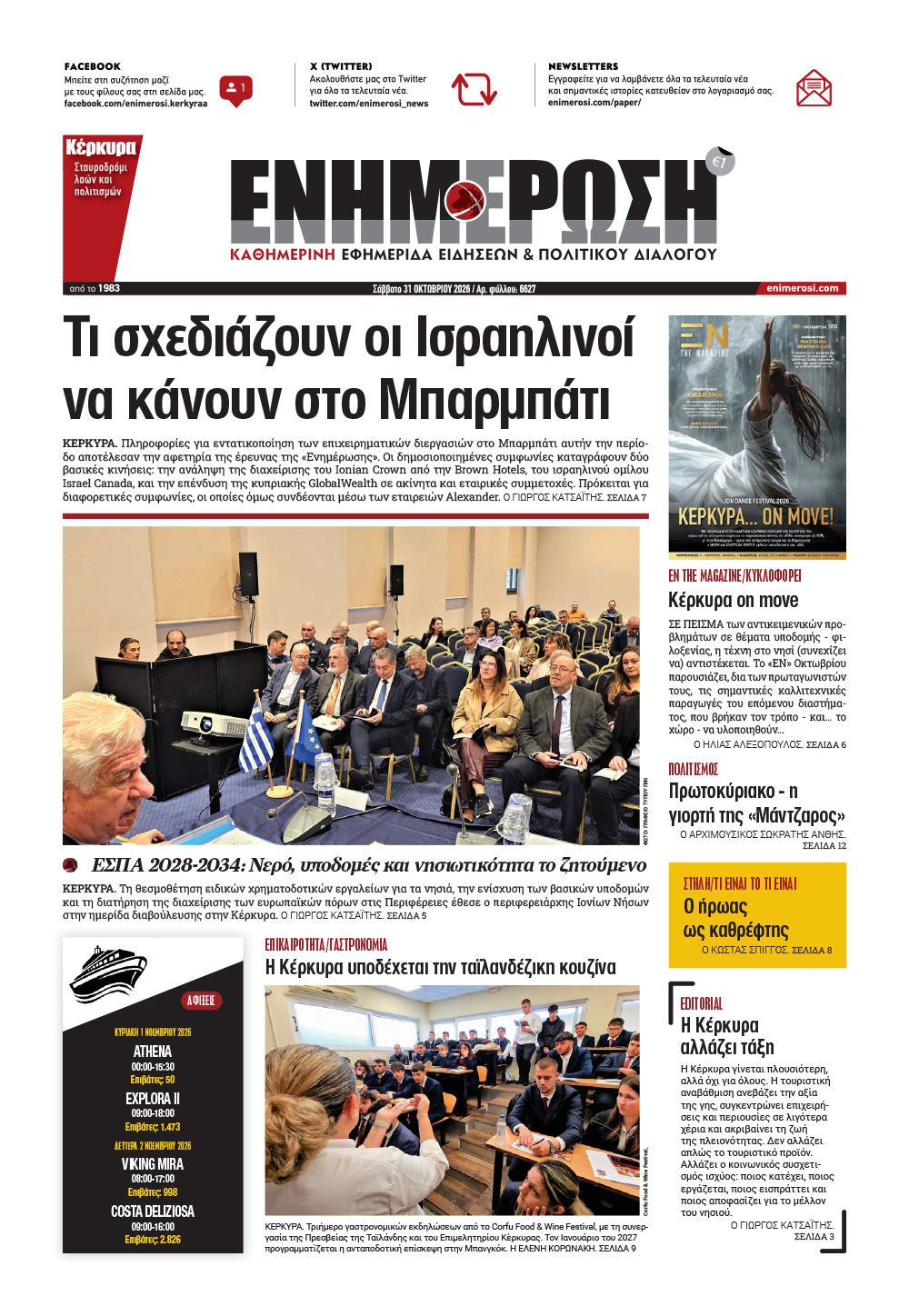
The consultation convened by Regional Governor Yiannis Trepeklis on the 2028–2034 development programme faces a major political issue: the uneven pattern of development across the Ionian Islands. This is a problem that cannot be addressed through the usual allocation of funds and a list of projects for each Regional Unit.
In Corfu, strong investor interest is evident in plans for a superyacht marina, proposed hotel developments and the search for new sites for investment. Economic activity is placing increasing demands on infrastructure that is already under strain. Water supply, sewage, waste management, transport and housing are struggling to keep pace, particularly at the height of the tourist season.
At the same time, other areas of the Ionian Islands, as well as parts of Corfu itself, are not facing the pressures of overdevelopment but rather a lack of development. Limited investment, inadequate services, population decline and the contraction of economic activity paint a very different picture.
This is where the contradiction lies. More developed areas need public investment to cope with the economic activity they attract. Less developed areas need public investment to generate economic activity and create prospects for the future.
These are not the same needs. Consequently, they cannot be addressed with the same approach.
Seasonality further exacerbates the problem. Infrastructure is expected to accommodate peak populations many times greater than the permanent resident population, while staffing levels and funding continue to be calculated primarily on the basis of static criteria.
The next development programme therefore requires a different approach to administration and public investment. In areas experiencing high concentrations of economic activity, the priority must be to strengthen the capacity and resilience of infrastructure. In less developed areas, the focus must be on creating productive capacity, improving services and establishing conditions that encourage people to remain.
Balanced development is not achieved by distributing funds equally, but by addressing unequal needs through differentiated policies.
This is the real challenge of the next seven-year period. Otherwise, public funds will continue to perpetuate the very imbalances they are supposed to correct.
GIORGOS KATSAITIS