Moscow, Nektarios and Saint Spyridon connection
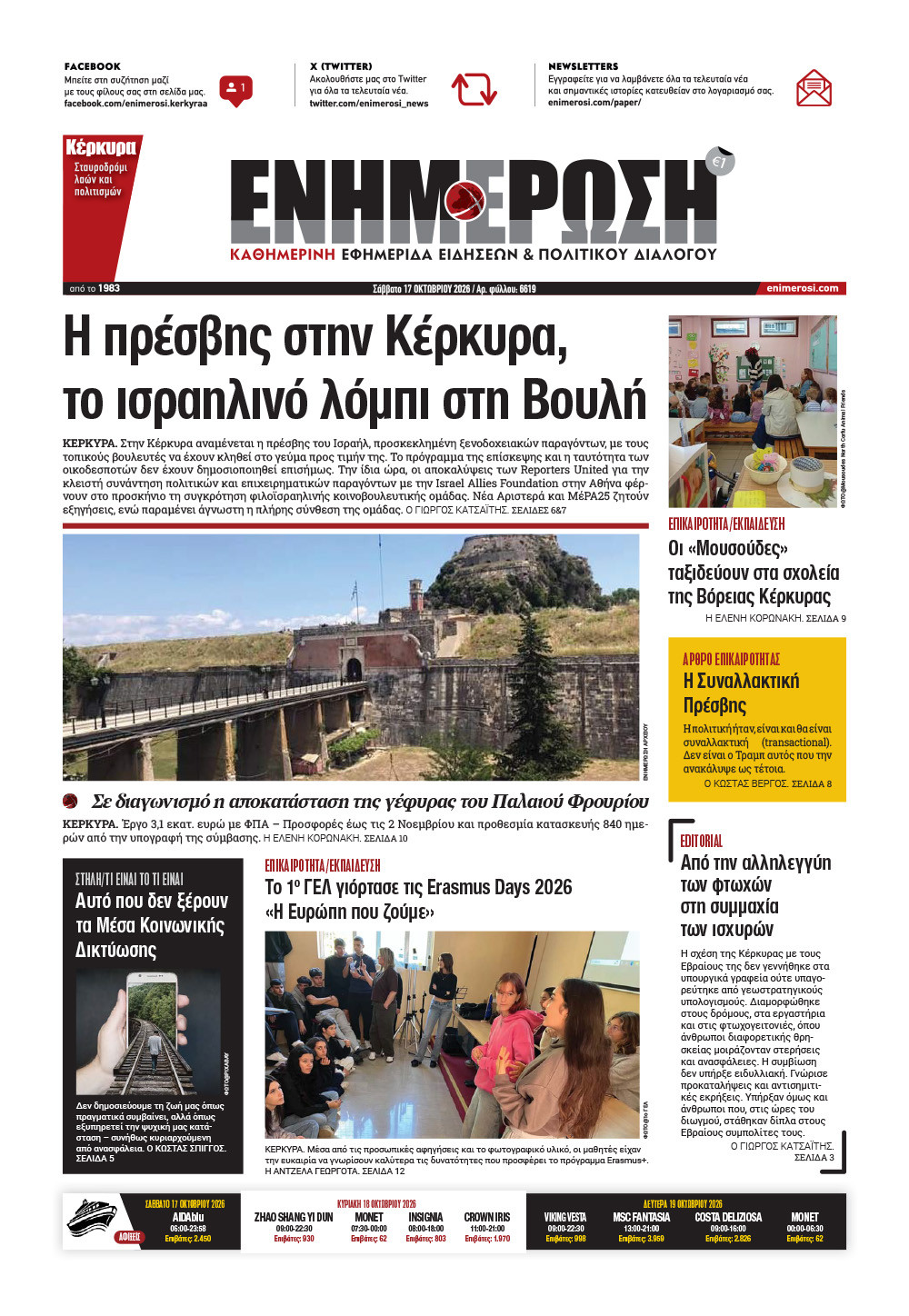
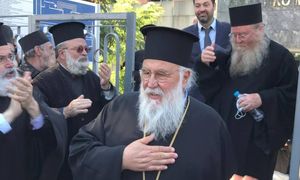
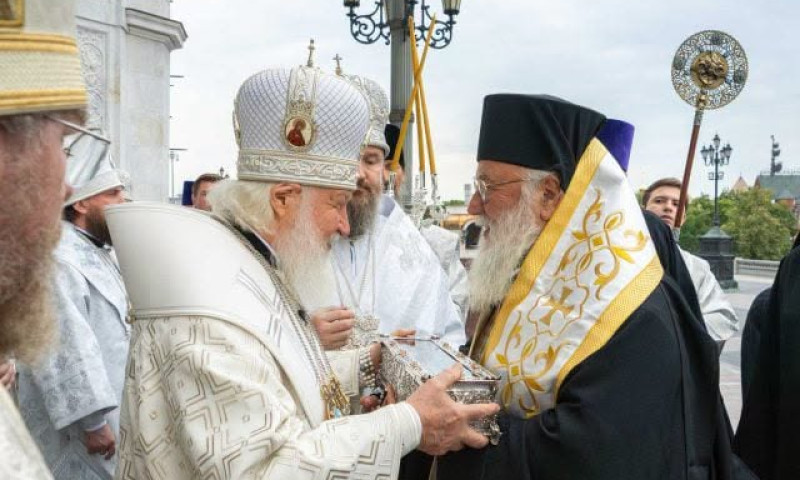 Patriarch Kirill of Moscow welcomes the relic of the right hand of Saint Spyridon at the Cathedral of Christ the Saviour, in the presence of Archbishop Nektarios of Corfu. A meeting of particular symbolic significance, against the backdrop of the ecclesiastical rift over the Ukrainian issue. Photo: ekklisiaonline.gr
MOSCOW. The transfer of the right hand of Saint Spyridon to Russia is more than simply a major pilgrimage event. Its official reception by Patriarch Kirill, and above all the presence of Archbishop Nektarios of Corfu, take on particular significance against the backdrop of the deep rift that the Ukrainian church issue has caused within the Orthodox Church.
Beyond the images of the ceremonial reception, the visit of Archbishop Nektarios of Corfu to Moscow carries clear ecclesiastical significance. Indeed, it carries even greater weight because it comes seven years after the dispute between Moscow and Athens over the recognition of the Autocephalous Orthodox Church of Ukraine.
The right hand of Saint Spyridon arrived in Russia at the invitation of Patriarch Kirill and with the approval and canonical permission of the Holy Synod of the Church of Greece. This is a crucial point: this was not a personal initiative by the Archbishop of Corfu, but rather the transfer of a relic carried out with the institutional consent of the Greek Church.
On the evening of August 18, Patriarch Kirill personally welcomed the relic at the Cathedral of Christ the Saviour, in the presence of Archbishop Nektarios. This followed a private meeting between the Archbishop of Corfu and Archbishop Anthony of Volokolamsk, head of the powerful Department for External Church Relations of the Moscow Patriarchate.
The subtle but significant distinction
There is, however, an important clarification to make regarding the description of the 2019 rupture. Moscow did not sever Eucharistic communion wholesale with all the archbishops of the Church of Greece.
The decision of the Russian Synod on October 17, 2019, provided for the severing of communion with those Greek hierarchs who entered into ecclesiastical communion or concelebrated with representatives of the new Ukrainian Church. At the same time, the same decision explicitly stated that Moscow would maintain canonical and Eucharistic ties with Greek bishops who did not follow this course.
And this is precisely where the particular position of Archbishop Nektarios of Corfu lies.
Archbishop Nektarios was among the archbishops who had not aligned themselves with the recognition of Ukrainian autocephaly. Indeed, the Russian Synod's 2019 statement itself records that, although he was absent from the extraordinary assembly of the Hierarchy of the Church of Greece on October 12, he had submitted his position in writing, expressing reservations about the way the process had been handled.
This also explains why his presence in Moscow today does not represent a departure by the Moscow Patriarchate from its own 2019 position. On the contrary, the Archbishop of Corfu is among the Greek hierarchs with whom the Russian Church could continue to maintain relations.
More than a pilgrimage
This, however, does not diminish the significance of the event. It enhances it.
Patriarch Kirill did not limit himself to receiving the relic. He publicly referred to the “brothers from Greece” and stressed that Greeks and Russians prayed “each in his own language,” addressing the same prayer to God. Within the current intra-Orthodox reality, this is hardly language that can be regarded as merely ceremonial.
It should also be noted that, based on what has been made public, there was no concelebration by the Archbishop of Corfu with the Patriarch of Moscow. What is documented is his presence at the vigil, the handing over of the relic, a shared ecclesiastical setting and private meetings. This distinction is significant at both the ecclesiastical and canonical levels.
The picture that ultimately emerges is that of a carefully opened door. The Ukrainian dispute has not been resolved, nor have relations between Moscow and the leadership of the Church of Greece been restored. Yet the official transfer of a major Corfiot relic, accompanied by Archbishop Nektarios and authorised by the Holy Synod of Greece, creates a genuine channel of communication.
And Saint Spyridon, who is immensely popular in Russia, becomes in this case something more than the object of a major pilgrimage: he becomes a safe ecclesiastical bridge between two sides that remain divided by the Ukrainian schism.
GIORGOS KATSAITIS