What roles do Corfu and Igoumenitsa play in hydrocarbon exploration?
CORFU. Which port will take on the crucial support role for this process at the northwestern tip of the country?
The region’s future in relation to hydrocarbon extraction may not rank high on the official agenda; nevertheless, it exists — at least for locals — in the back of their minds. These thoughts are becoming increasingly tangible and less a product of sensitive imagination, due to progress in the matter. Only recently were contracts signed between the Greek State and the Chevron–HELLENiQ Energy consortium for the launch of exploration in the offshore blocks “South Peloponnese,” “A2,” “South of Crete I,” and “South of Crete II.”
Inevitably, discussion has been renewed about the pivotal role of the country and of this particular maritime corridor, which, after all, has featured in geopolitical analyses over the past three decades.
The reference is to the vertical natural gas corridor, consisting of the country’s liquefied natural gas (LNG) reception and regasification infrastructure and the interconnector pipelines to Southeastern European countries. This strategy is promoted as a key option for substituting Russian natural gas, which, under the current European framework, will cease to be imported into the EU by the end of 2027.
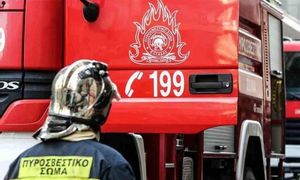
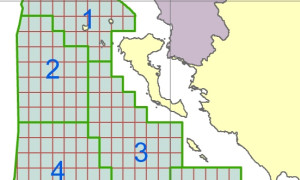
During the same period, the next step is also expected: the exploratory drilling in “Block 2” in the Ionian Sea by the ExxonMobil–Energean–HELLENiQ Energy consortium.
At precisely this point, the question arises regarding the region’s changing profile: which port will undertake the necessary support for this process at the country’s northwestern edge? A question that is not rhetorical and is accompanied by a second, almost “existential” one: to what extent can models of high-end tourism coexist with those of industrial and energy services?
And while the private tourism sector has focused its interest on the entire coastal zone of Corfu, from Mouragia to Potami, and the concessionaire in Igoumenitsa presents a master plan that can hardly be described as tourism-oriented, reasonable concerns are emerging among local and neighbouring institutions, which are reacting against its acceptance.
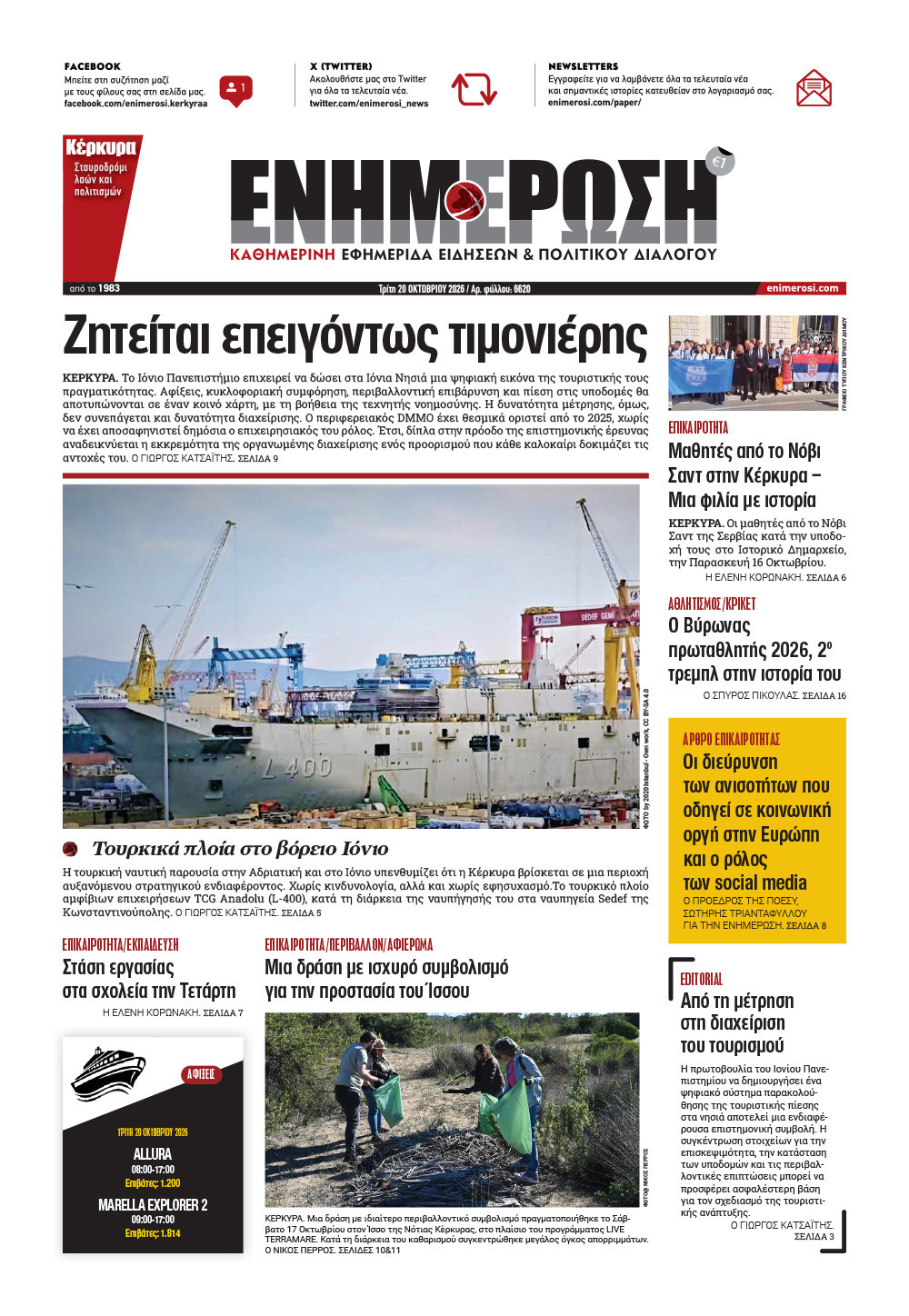
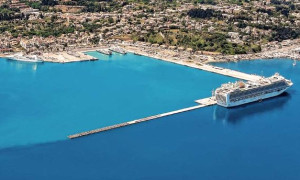
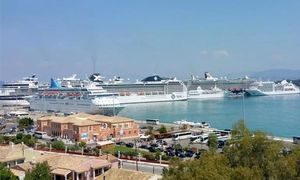
If hydrocarbon extraction (such as natural gas) begins west of Corfu, in the area of Block 2 approximately 30 kilometres from the island, there is currently no documented and sufficient infrastructure in Corfu specifically designed for offshore activities to support equipment, supply, and drilling vessels. The Port of Corfu remains primarily passenger-oriented, touristic, and commercial, with emphasis on ferry services and cruise ships, lacking large-scale specialised facilities for extraction support.
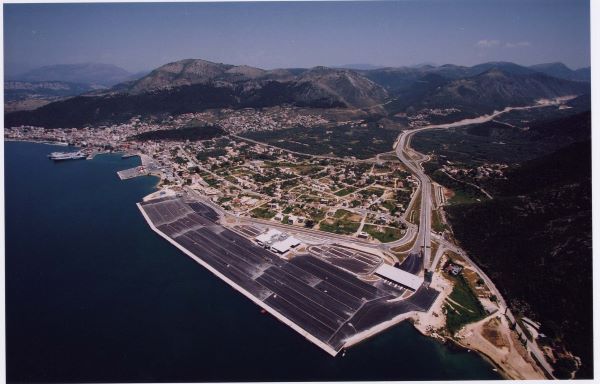
By contrast, the Port of Igoumenitsa ranks among the country’s most significant commercial and transport ports, capable of serving trucks, general cargo, tankers, and support vessels. The Press Release of OLIG (Igoumenitsa Port Authority) regarding the New Master Plan 2025 records specific elements that strengthen or further define its support capacity, enabling it to function as a supply base and logistics hub for activities in the Ionian Sea beyond ferry services.
However, OLIG’s text does not explicitly state that Igoumenitsa is designated as a drilling supply base. The master plan, as presented, generally upgrades infrastructure — in areas such as logistics, fuel, power supply, and storage facilities — which are necessary preconditions for a support role, yet it does not in itself substantiate that the town is “assigned” as the primary offshore supply base.
The modern “energy corridor” — pipelines, ports, vertical axes, and logistics networks — can be viewed as a geoeconomic revival, in a new form, of the old commercial axis Trieste–Corfu–Patras–Syros of the 18th and 19th centuries. Not as a simple replication, but as a reuse of the same geographical “skeleton” of power. When the global system changes, old corridors are revived. Today, Corfu lies more “beside” the new energy axis than “on” it. It tends to function more as the “Nice of the Adriatic” than as the “Trieste of the 21st century.”
In the 18th and 19th centuries, Corfu and Igoumenitsa had entirely different profiles: Corfu operated as a key commercial, maritime, and administrative centre of the Western Mediterranean, integrated into the major sea routes linking the Adriatic with the East, while Igoumenitsa was a small coastal community without particular economic weight. Today, the roles appear to be reversing. Corfu has consolidated its position as an international tourism and cultural destination with limited industrial and transit functions, while Igoumenitsa — thanks to its road connections, port upgrade, and geostrategic position — has the greater potential to develop into a major transport and energy hub in Western Greece, assuming a role in the Ionian area once held by Corfu.
GIORGOS KATSAITIS