Greek premiere of Requiem by Nicolas Charles Bochsa in Corfu
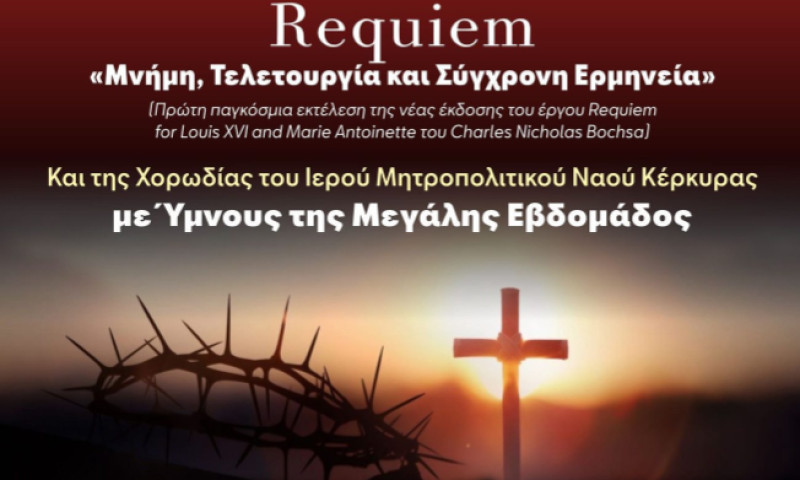
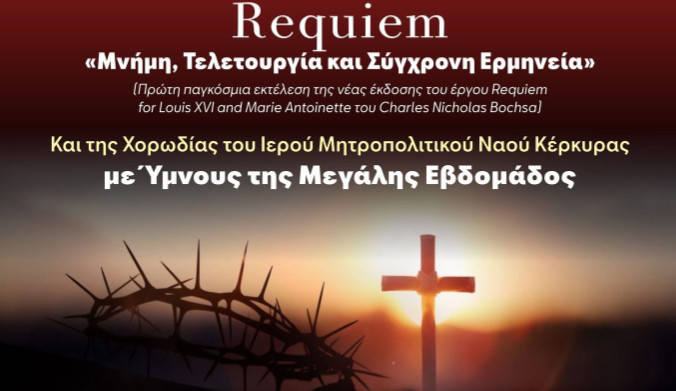
CORFU. Capodistrias Philharmonic Society is presenting, for the first time in Greece, a monumental 19th century work on Palm Sunday, April 5.
On Palm Sunday, April 5, the imposing Church of Saint George in the Old Fortress will host an exceptional musical event: the Greek premiere of Réquiem pour Louis XVI et Marie Antoinette by Nicolas Charles Bochsa. The Capodistrias Philharmonic Society, with choir and vocal soloists, will perform for the first time in our country a work that remained almost unknown for two centuries, despite its monumental importance in the history of music for wind ensembles. As the conductor of this premiere, I feel deeply moved that this masterpiece will finally be heard in Greece — and indeed on the island with the longest philharmonic tradition in the country.
The Requiem was composed in 1815, on the occasion of one of the most symbolic events of post-Napoleonic France. After Napoleon’s first defeat and the Bourbon Restoration, the new government decided to honour the victims of the Revolution. On January 21, 1815 — exactly on the anniversary of the execution of Louis XVI — a grand ceremony was held in Paris for the reburial of the remains of the king and Marie Antoinette. For this occasion, the French government commissioned two Requiems: one from Luigi Cherubini, already an established composer, and one from the young but equally ambitious Bochsa. On that very same day, in distant Vienna, a similar ceremony took place at St. Stephen’s Cathedral, organised by Talleyrand on the sidelines of the Congress of Vienna, featuring a Requiem by Sigismund Neukomm under the direction of Salieri — the simultaneous performance of funeral works in two European capitals reveals the profound political and emotional weight of that era.
Nicolas Charles Bochsa (1789–1856) was one of the most talented and, at the same time, most adventurous musicians of the 19th century. A child prodigy, he performed a piano concerto at the age of seven, composed a flute concerto at eleven, and a ballet at twelve. He studied at the Paris Conservatoire with Catel and Méhul, collaborated with Érard on the invention of the double-action harp, and produced studies for the instrument that are still in use today. Napoleon appointed him official harpist of the imperial court in 1813, while critics of the time praised the “warmth and dramatic truth” of his music. He was dubbed “the Paganini of the harp,” and an American critic famously wrote that “his hands produce harmonies as pure and silvery as one might imagine emanating from the golden strings of cherubim.”
His life, however, reads like a novel. Forgeries and financial scandals forced him to flee France for London, where he founded the Royal Academy of Music modeled on the Paris Conservatoire. With his partner, the celebrated soprano Anna Bishop, he toured throughout Europe, Russia, North and Latin America, eventually reaching Australia, where he died in January 1856. At his funeral in Sydney, local musicians formed a procession performing the slow movement of Beethoven’s Third Symphony.
But what will the audience in Corfu hear? A large-scale work, written for wind ensemble, choir, and three vocal soloists (alto, tenor, and bass), in fifteen movements that unfold the full spectrum of human emotion. The evening opens with a dark funeral march — Marche funèbre — for band alone, immediately immersing the listener in an atmosphere of mourning. This is followed by the Kyrie eleison, where the three soloists interweave their voices with the winds in an intense plea.
Next, the choir takes centre stage in the terrifying Dies Irae — the Day of Wrath — where Bochsa gradually builds a sonic storm by expanding the number of singers, in an unusual crescendo that escalates to devastation. The Tuba Mirum, featuring a bass solo accompanied by four trumpets, depicts the trumpet of the Last Judgment in breathtaking fashion. Particularly tender moments are offered by the Recordare, an idyllic duet between solo English horn and alto voice, accompanied only by a small Harmoniemusik ensemble — clarinets, bassoons, and horns — creating an almost chamber-music atmosphere within the grandeur of the work.
A highlight is the Amen fugue, one of the most ambitious contrapuntal pieces I have encountered in the wind repertoire. Bochsa constructs a dense, multi-layered structure of sound that, according to scholar David Whitwell, “resembles the impression one hears in a large cathedral, when the overtones of the organ accumulate in the space above the listener.” In the stretto, choir and winds intertwine in a sonic complexity unprecedented in any composition before 1815. In contrast, the Pie Jesu brings serenity: a beautiful quartet for alto and bass voices, horn, and harp — perhaps the most intimate moment of the entire work.
The modern edition of the score is due to the American musicologist and my mentor, David Whitwell, who restored it in 2015, bringing back to life a work that history had unjustly neglected. My personal connection with Whitwell and his deep knowledge of this repertoire were the starting point and inspiration for bringing Bochsa’s Requiem to Greece.
There could be no more fitting setting for this premiere. Corfu, with its unique philharmonic tradition in Greece — inseparably linked to wind ensembles — is the ideal place for this monumental Requiem to be heard. The Church of Saint George, with its acoustics and grandeur, will lend the work the liturgical atmosphere for which it was originally conceived. Palm Sunday, a day of solemn reflection but also of hope, offers the perfect spiritual context for this encounter with History through Music. We look forward to welcoming you.
MICHALIS MICHALOPOULOS