How Corfu engineers perceive the town and how they wish it to evolve
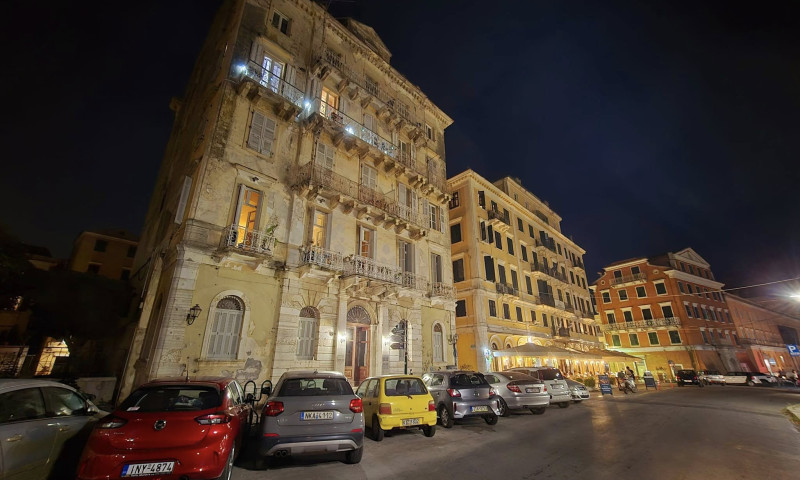 Να δοθεί η δυνατότητα εύκολης παρέμβασης στις όψεις των κτιρίων για επισκευές τοπικής σημασίας. (ΑΠΟ ΤΟ ΚΕΙΜΕΝΟ ΤΟΥ ΤΕΕ). ΦΩΤΟ@ΣΤΑΜΑΤΗΣ ΚΑΤΑΠΟΔΗΣ
CORFU. The Corfu Branch of the Technical Chamber of Greece (TEE) on the Urban Operating Regulations for Corfu Town.
(From TEE document) Guidelines and Recommendations for Corfu Town Urban Regulations.
The placement of tables and chairs for food and beverage establishments in squares, pedestrian streets, and pavements should correspond to the size of the interior space of each establishment and the actual number of people it can accommodate. Outdoor seating should never create the impression of private space. The use of arcades for tables and chairs should be evaluated according to the arcade’s purpose and location, considering that arcades serve pedestrian circulation and provide shelter from weather. Each case should be assessed individually. Furthermore, requiring a mechanical engineer to certify the structural adequacy of umbrellas is considered an inappropriate measure.
- Social and political activities in public spaces should follow the same rules as cultural events. Imposing long advance notification requirements or demanding municipal council approval for events organised by citizens’ associations, social groups, or political organisations effectively restricts political activity in the public spaces of the Old Town. This risks depopularising these spaces and converting them into purely commercial areas. A committee representing all social and political perspectives should be established to provide guidance. Alternatively, specific outdoor areas could be designated for social or political events, with clear requirements and guarantees to ensure proper use.
- The town should serve as a natural platform for artistic expression. Street musicians, painters, and other performers have been part of European cultural tradition since the Middle Ages. No regulation should turn street art into a profession or restrict artists experimenting in public spaces. The proposed 80 dB noise limit should be reduced to 50 dB. A scheduling platform could allow artists to declare their intended location and time, ensuring that the town’s capacity and the duration of each activity are managed effectively. Distinguishing student artists from other performers is unnecessary and does not enhance the dissemination of art or the presentation of work.
- High aesthetic standards should be promoted as a core value that enhances quality of life. Special attention should be given to the restoration and improvement of building façades by limiting or prohibiting the display of merchandise in exterior areas and on building fronts. For establishments with a single opening, display cases should be standardised at 40 cm wide and 1.8 m high.
- For interventions, repairs, and renovations, the regulation should recognise that the town has developed over centuries through both formal and vernacular architecture. The architectural ensemble of the town includes numerous modern and neoteric buildings that should not be treated the same as traditional or Venetian-era buildings. The use of metal frames has historically been appropriate in many buildings with professional or mixed uses, and mandating wooden frames in all cases is unnecessary.
- The installation of lifts should be facilitated wherever possible.
- Minor repairs to façades, such as painting or plastering, should also be made simple to implement. Standardised procedures for materials, colour palettes, and frame types should be agreed upon with the Ministry of Culture and categorised by area (Old Town, Buffer Zone, New Town, etc.). Every intervention should consider the type of building (monument or modern) and its location. Approval processes should be streamlined, requiring only essential documentation (e.g., technical report, photographs), supervised by Old Town Office staff. Consequently, the regulation should remove the requirement for a full architectural study, including pathology analysis, restoration proposals, and supplementary information for each intervention. Therefore, to simplify procedures, the regulation should remove the paragraph stating: “Interested parties must submit a complete architectural study file with as-built and proposed plans, a technical report containing pathology analysis, restoration proposal, and any additional information deemed necessary by the Corfu Antiquities Authority, depending on the interventions, works, etc.”
- Buildings should also be categorised by construction period or character. For restoration and maintenance of buildings that are monuments, pre-1830 (requiring recognition of construction phases in buildings with permits) or later monuments designated by the Ministry of Culture, supervision should be carried out by Ministry of Culture architects in collaboration with the Old Town Office. For non-monument buildings, more flexible and contemporary morphological rules should apply, allowing, for example, aluminium or plastic windows in specified colours, installation of Greco-Roman tiles, exterior thermal façades, etc. Morphological rules may vary depending on the broader city area but should always be standardised and clear. These rules for non-designated buildings should be proposed by the Old Town Office, reviewed by the Architectural Council, approved by the Ministry of Culture, and applied and supervised by the Old Town Office.
- Scaffolding placement only on upper floors is excessive. The type of scaffolding should be evaluated case by case, and if a traditional scaffold does not obstruct pedestrian circulation, as in the case of tables and chairs, and does not cause other safety issues, it should be preferred as a more economical solution. In all cases, technical specifications for scaffold installation and the Safety and Health Plan included in the work permit file must be followed.
- The installation of metal canopies at building entrances should be allowed.
- A standard equipment specification for establishments (chairs, etc.) should be provided.
- The regulation should establish measures and obligations to make public spaces known to everyone.
- Pilot implementation of measures should be promoted for several years, with incentives for businesses or citizens who adopt them early (even before formal adoption of the regulatory provision).
- The regulation should provide for the operation of a service responsible for standardising rules, recording the effectiveness of measures, and monitoring compliance (e.g., Old Town Office).
- An open consultation process and regular review of measures and provisions should be provided. The regulation should include procedures for evaluating proposed measures and revising them as necessary at regular intervals.