Municipal Theatre as an icon: What Corfu is really nostalgic for
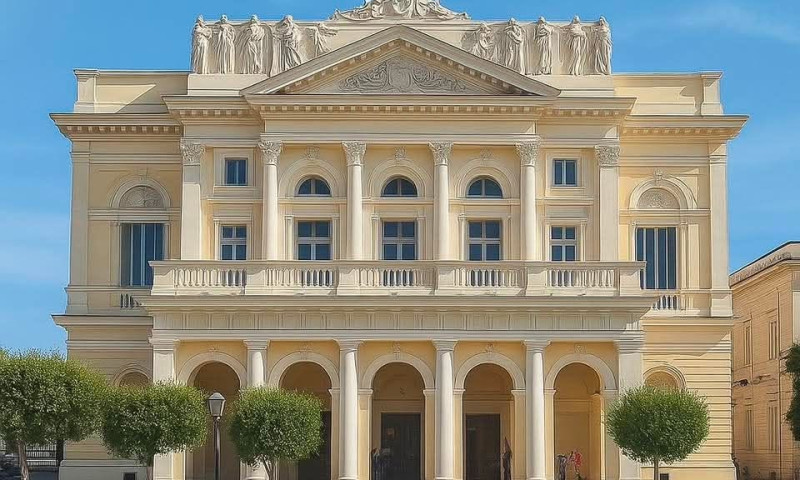 The history of the old Municipal Theatre sheds light on a deeper contradiction in Corfu’s identity: the descendants of the popolari do not long for the aristocracy, but for the aesthetic ambition that it left behind as a public legacy. Photo: Stamatis Katapodis (AI)
CORFU. It was not merely a replica of La Scala in Milan, nor simply a victim of bombing. The old Municipal Theatre was the aristocratic legacy appropriated by the common people, and its loss continues to haunt Corfu’s self-image.
The old Municipal Theatre of Corfu is not simply a lost building. It is a way in which the town narrates itself.
The theatre was not a creation of the bourgeoisie, as was the case in many European cities. It was the final cultural gesture of Corfu’s aristocracy, heir to the Venetian tradition, which held that power ought to be surrounded by grandeur and high aesthetics. The replica of La Scala in Milan was not built for the common people. And yet, with the end of the monarchy and the social rearrangements of the interwar period, it was the common people who appropriated it.
The quality of the repertoire may have declined by the standards of the old elites. However, ordinary Corfiots felt that they had inherited a cultural infrastructure superior to their social and economic means. They did not demand a “popular” theatre adapted to their measure. They claimed the right to inhabit an aesthetic designed for the few and to transform it into a common good.
Perhaps that is why, even today, photographs of the old Theatre can be found in barber shops, workshops, and butcher shops in the Old Town—not in the salons of the descendants of the aristocracy, but in spaces of everyday labour. Like icons. Not of a lost aristocracy, but of a collective self-esteem.
The great irony is that the Theatre was not lost solely due to war. Its shell had survived to a degree that allowed for different choices. Postwar Corfu chose not to restore it. Sakellarios appeared later, embodying a form of modernisation that had already decided to break the town’s morphological continuity. He was not the executioner, but the architect of an already made decision.
Today, the discussion around the New European Bauhaus takes on unexpected relevance. Europe is asking how cities can remain sustainable without losing their memory. Corfu poses the same question in different terms: can a society preserve the aesthetic continuity that shapes it without freezing it into a museum?
Perhaps, in the end, this is what Corfiots mourn—not only a building, but a lost possibility: to continue becoming heirs to a beauty they believed belonged to them.
GIORGOS KATSAITIS