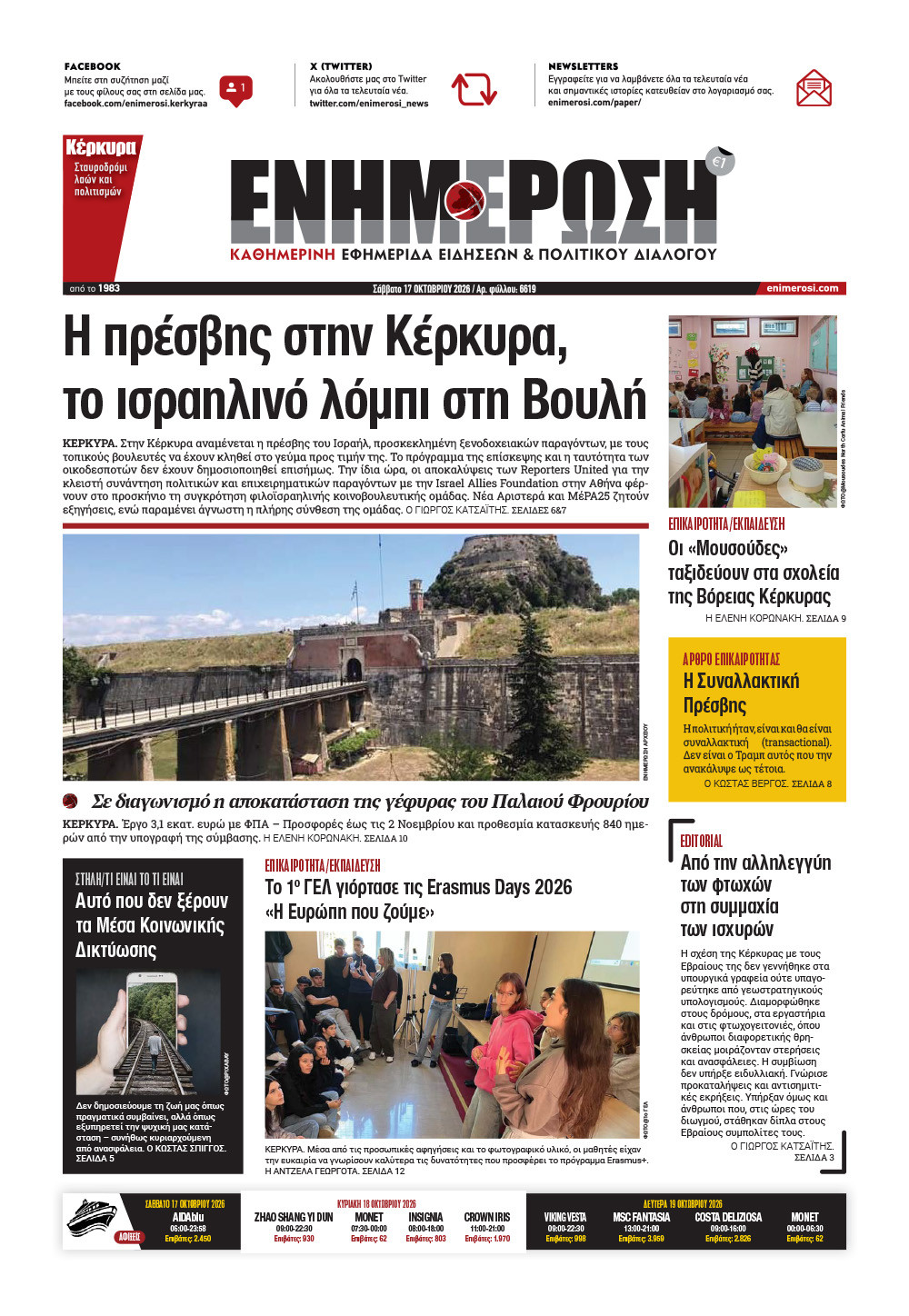
Juvenile violence in Corfu: Screen culture and normalisation of aggression

The incident involving the injury of a pupil in Corfu once again brings to the forefront the discussion about juvenile violence, the influence of the media and social media, as well as the social model shaping a generation raised amid tension, competition, and constant exposure to aggression, while parents are away at work from morning until night.
The incident of violence between underage pupils in Corfu, which resulted in the injury and hospitalisation of a child, cannot simply be treated as yet another “isolated incident.” Every such case undoubtedly has its own specific background, personal responsibilities, and family and school-related factors. Yet it would be dangerous to pretend that it occurs in a social vacuum.
My first encounter with this phenomenon came during my long stay in Germany in the late 1970s, while watching television and witnessing the striking emergence of violence as a form of everyday spectacle. It surprised and troubled me. Shortly afterward, confirmation came from Japan, except that there the violent scenarios were carried out through cartoons and animation. What at the time seemed like cultural excess or an exotic characteristic of distant societies has today become an almost global model of entertainment.
The daily conditioning to violence — often in its most twisted, humiliating, and inhumane forms — has now become a dominant pattern both in traditional media and on social media. The difference is that violence is no longer presented merely as narrative, but as constant stimulus, as high-consumption spectacle, as content rewarded with views, likes, and algorithmic promotion.
Today’s minors are growing up amid a relentless stream of images of aggression: humiliation, beatings, public shaming, “pranks” that turn into abuse, even real murders or scenes from war — all appearing on the same screen alongside advertisements, music, and consumerist role models. Shock becomes routine, and tension becomes normality.
Of course, this is not solely a media problem. Violence is not born exclusively on the screen. It develops within a social environment where families are economically exhausted, parents are absent from home for long hours, schools often function defensively, and society itself seems to have lost common points of reference.
From the 1980s onward, with the dominance of an extremely competitive economic and cultural model — especially after the collapse of the socialist counterbalance — collective values retreated before individualism. Success became a personal affair, failure an individual stigma, and society a continuous struggle for survival and visibility. In such an environment, aggression does not always appear as deviation, but often as a tool for dominance and recognition.
Social media merely completed the process. Anger, conflict, and humiliation generate “traffic,” and therefore economic value. The algorithm rewards intensity far more than composure.
It is therefore hardly surprising that children raised under this constant emotional pressure struggle to manage anger, frustration, or conflict. What is alarming is not only the increase in such incidents, but the risk that society itself may become accustomed to them.
And yet, the answer cannot be either moral panic or nostalgia for authoritarian models of the past. The challenge is not to return to fear, but to rediscover boundaries, communities, meaningful education, and the genuine presence of adults in children’s lives.
Because if society trains people in violence every single day, then someone must finally take responsibility again for teaching human coexistence.
GIORGOS KATSAITIS