Exploratory drilling: full Regional Council decision published
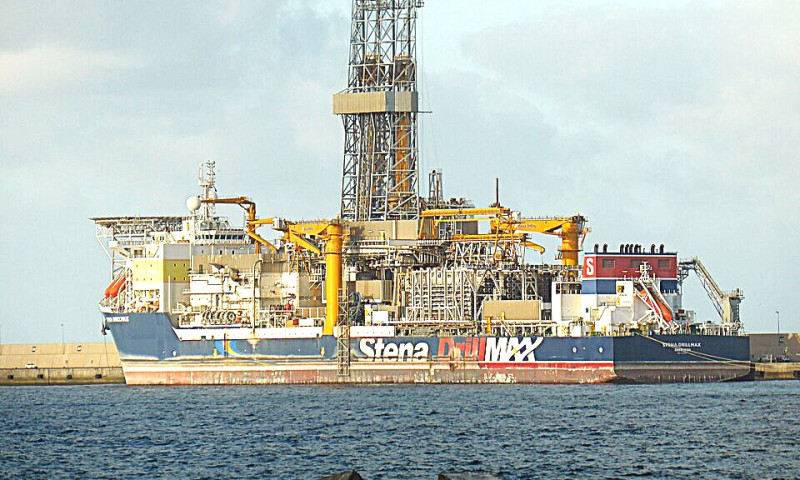 The Stena DrillMAX, the drillship selected for the exploratory well in Block 2. Photo: Carlos Teixidor Cadenas / Wikimedia Commons / CC BY-SA 4.0. Wikimedia Commons
CORFU. The Ionian Islands Regional Authority has published the full text of its decision on the Asopos-1 project. The positive opinion relates to the exploratory drilling, incorporates the 17 conditions set out in the relevant department’s recommendation, and provides for further political discussion if the exploration leads to development and exploitation. No monitoring body has yet been formally established, nor has a specific percentage of compensatory benefits been agreed for the Diapontia Islands.
With the publication of the full text of Decision 185-22/05-10-2026, it is now clear exactly what the Ionian Islands Regional Council decided regarding the Asopos-1 exploratory well in Block 2 of the Ionian Sea.
The decision was initially published on 6 October and updated on 27 October with the full extract from the meeting minutes. It concerns the opinion on the Environmental and Social Impact Assessment (ESIA) for the “Hydrocarbon Exploration Programme – Exploratory Well ‘Asopos-1’ in Block 2 – Ionian Sea”.
The Regional Council issued a positive opinion by majority vote, adopting the recommendation of the Ionian Islands Regional Directorate of Environment and Spatial Planning. This means that the 17 conditions laid down by the department did not remain merely recommendations but became the framework underpinning the political decision to give the project the green light.
Yes to exploratory drilling – no blank cheque for exploitation
The crucial distinction concerns the next stage. The decision does not constitute advance approval for the development and exploitation of a deposit. Instead, it calls for the State to establish a specific, clear and binding framework for compensatory benefits for the Ionian Islands Region and the directly affected local communities, with particular provision for the Diapontia Islands, if the exploratory well produces positive results and before any development and exploitation permits are issued. The matter is to return to the Regional Council at that stage for further discussion and a new decision.
This wording ultimately reflects the position that emerged during the meeting: consent to exploration now, followed by a fresh political assessment if the results point to a genuine prospect of exploitation.
This position places the Ionian Islands Region broadly in line with the Region of Epirus, whose Environmental Committee had already issued a positive opinion by majority vote on the same exploratory well.
The 17 conditions
The technical recommendation adopted by the political decision sets out 17 conditions.
The first requires the implementation of all measures for preventing and addressing environmental impacts specified in the Environmental and Social Impact Assessment.
Drilling operations and onshore logistics movements must, as a priority, take place during the first four months of the year, so as not to coincide with the peak tourist season from 15 May to 30 September. The drillship must remain at the site for no longer than 90 days.
One of the two support vessels stationed alongside the drillship must be certified for oil recovery operations and equipped with at least 500 metres of offshore floating containment booms, a high-capacity pumping system and storage tanks with a capacity of at least 500 cubic metres.
To protect cetaceans, the exclusion zone during the Vertical Seismic Profiling (VSP) test is extended from 500 to 1,000 metres. Sound emissions must begin with a gradual increase in power over at least 30 minutes. If a cetacean is detected within the zone, the procedure must be suspended and may not resume until at least 45 minutes after the animal was last recorded.
Special provision due to proximity to Italy
Because the drilling site is just 3.16 km from the Italian Exclusive Economic Zone (EEZ) boundary, one condition requires an official operational liaison and communications memorandum with the Italian Coast Guard and the Region of Apulia to be in place before work begins. This is intended to ensure that resources on both sides can be mobilised immediately in the event of a transboundary pollution incident.
An updated marine pollution emergency response plan is also required, along with permanent pollution-control equipment on the drillship and support vessels, an active contract with a marine pollution response organisation, and a binding agreement guaranteeing the availability of a Well Capping Stack, together with a plan for the possible drilling of a relief well.
Drilling fluids and cetaceans
The use of drilling fluids is restricted exclusively to water-based fluids. The use or discharge into the sea of non-aqueous oil-based or synthetic-based muds is prohibited, and limits are imposed on heavy-metal concentrations in barite.
During the seismic test, at least two certified marine mammal observers and two passive acoustic monitoring operators must be present. Thermal cameras must also be used at night or in conditions of limited visibility.
Two years of environmental monitoring
The company is required to fund an independent environmental monitoring programme conducted by a recognised academic or research institution.
The programme must begin 15 days before drilling, continue throughout the operation and extend beyond the abandonment of the well, with further sampling at six, 12 and 24 months.
Monitoring will include, among other things, petroleum hydrocarbons and polycyclic aromatic hydrocarbons, heavy metals, benthic indicators and environmental DNA. Reports must be submitted to the Ministry of Environment and Energy and the Ionian Islands Regional Authority.
Before operations begin, an environmental liability insurance policy of sufficient coverage must also be in place to cover damage to natural resources and third parties resulting from a major accident.
Waste and maritime movements
Solid drilling cuttings may be discharged into the sea only if laboratory tests demonstrate that they contain no naturally occurring hydrocarbons. If hydrocarbons are detected, discharge must cease and the materials must be transported ashore.
The discharge into the sea of plastics, lubricants, sludge, solvents, chemical containers, batteries, electrical equipment and medical waste is also prohibited. Waste must be transported to approved facilities at the Port of Igoumenitsa and recorded in the Electronic Waste Registry.
A maximum oil content of 15 parts per million (ppm) is set for bilge water. Full biological treatment of sewage and the use of an approved ballast-water treatment system are also required.
Support vessels travelling between Igoumenitsa and the drilling site must not exceed 10 knots when passing through sensitive areas where cetaceans and sea turtles congregate. The drillship’s lighting must be restricted and directed towards the interior of the deck to protect migratory birds. Regular safety and emergency response drills are also required.
The Diapontia Islands called for 1.5% – but it was not included in the decision
The meeting minutes also record in detail the proposals put forward by the Othoni Cultural Society. Among other things, it called for a legally guaranteed share of 1.5% of any potential benefits from exploitation to be allocated directly to the local communities of the Diapontia Islands, an independent environmental monitoring mechanism, and additional safeguards for fishing and tourism.
That specific percentage does not appear in the operative part of the decision. Instead, the final decision calls more generally for a binding framework of compensatory benefits for the Ionian Islands Region and the affected local communities, with specific reference to the Diapontia Islands.
Environmental Monitoring Body deferred
The full minutes also clarify what happened to the proposal for a Regional Environmental Monitoring Body.
Regional Governor Yiannis Trepeklis stated that the Regional Authority viewed the proposal favourably and agreed that it should be considered at a later stage. He also stressed that the Regional Authority wanted to participate actively in a public oversight mechanism. However, the establishment of the Monitoring Body was not included in the operative part of this particular opinion.
Earlier in the discussion, the ANASA regional faction had proposed rejecting the Environmental and Social Impact Assessment and immediately activating the Regional Environmental Monitoring Body, citing Article 86 of Law 4602/2019.
Who voted against
The final decision records seven votes against: Theodoros Galatsatos, Alexandros Michalas, Dionysios Giakoumelos, Alexandra Balou, Nikolaos Gisginis, Panagiotis Sofos and Maria Dri.
Initially, 27 of the 35 regional councillors were recorded as present at the meeting. Rodi Kratsa and Michael Diavatis joined remotely during the discussion.
The next step
The Ionian Islands Regional Authority's decision is advisory. It is neither an Environmental Terms Approval (AEPO) nor a permit to begin drilling. The file remains within the environmental licensing process as a Category A1 project. Final environmental approval rests with the Ministry of Environment and Energy. The Regional Authority officially received the file for consultation on 24 August.
GIORGOS KATSAITIS