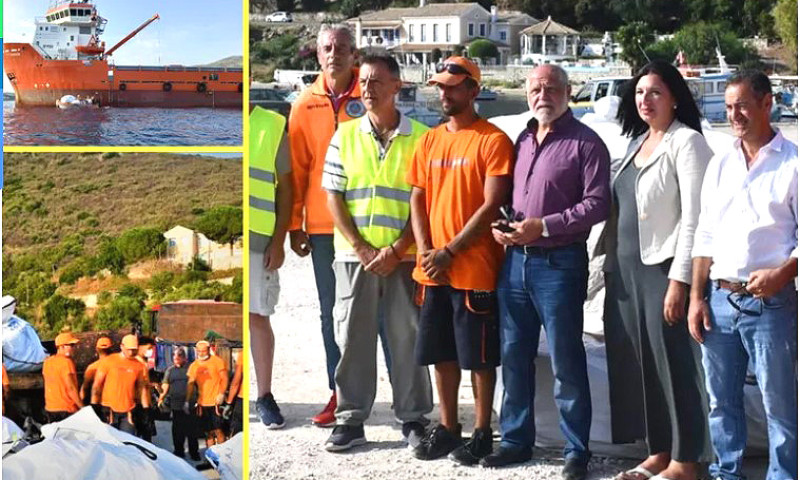
Typhoon Project collected 8 tons of waste from Corfu and Diapontia Islands last time they were here
CORFU. Four years after the first major operation, the Typhoon Project enters its second round of clean-ups – New comparative data sought for Corfu’s coastline
Eight tonnes of waste were removed in just 17 days from hard-to-reach beaches on Corfu and the Diapontia Islands when the Athanasios C. Laskaridis Charitable Foundation vessel Typhoon visited the Ionian in August 2022. Four years later, the Typhoon Project is now in its second round of clean-ups along the Greek coastline, raising a reasonable question: how much has the condition of Corfu’s coastline changed in the meantime?
The 2022 operation was carried out in cooperation with the Municipality of North Corfu and covered the entire island as well as the Diapontia Islands. For 17 days, the 72-metre-long Typhoon, accompanied by five crewed inflatable boats and a specialised team of 34 people, operated along beaches that were not easily accessible from land, from the Kassiopi–Albania straits to southern Corfu, as well as on Othoni, Erikousa and Mathraki.
The operation was completed on 26 August. The waste was transported to Imerolia in Kassiopi and handed over to the municipality’s sanitation service. The results were striking: eight tonnes of waste packed into 116 big bags, of which approximately 300 kg consisted of recyclable materials. Among the items collected were plastic bottles and bags, polystyrene foam, nets, ropes and other fishing-related waste.
Seven years of the Typhoon Project
The Corfu figures have taken on renewed interest with the Typhoon Project reaching its seventh year. According to the Foundation’s latest figures, since 2019 almost 5,000 hard-to-reach beaches across Greece have been cleaned and more than 1.1 million kg of waste have been removed.
The programme has now entered its second full cycle of clean-ups, meaning it is returning to areas where it has already operated. As a result, it is not limited to removing waste, but is also generating comparative data showing whether, and to what extent, pollution reappears.
In summer 2026, for example, the second cycle was completed in Syros, Mykonos, Delos, Antiparos, Despotiko and Keros, with the Foundation recording an overall improvement in the condition of the beaches compared with the first intervention.
The Corfu figures have taken on renewed interest with the Typhoon Project reaching its seventh year. According to the Foundation’s latest figures, since 2019 almost 5,000 hard-to-reach beaches across Greece have been cleaned and more than 1.1 million kg of waste have been removed.
The programme has now entered its second full cycle of clean-ups, meaning it is returning to areas where it has already operated. As a result, it is not limited to removing waste, but is also generating comparative data showing whether, and to what extent, pollution reappears.
In summer 2026, for example, the second cycle was completed in Syros, Mykonos, Delos, Antiparos, Despotiko and Keros, with the Foundation recording an overall improvement in the condition of the beaches compared with the first intervention.
The question for Corfu
So far, however, no corresponding second-round assessment for Corfu and the Diapontia Islands has been found to have been published. And this is precisely where the local significance of the anniversary lies.
The 2022 survey now provides a clear baseline: eight tonnes of waste removed during a 17-day operation. A second cycle could therefore show whether the same hard-to-reach beaches have filled up with waste again, which types of waste persist, and to what extent the pollution originates from local activities or is carried by sea currents.
What is now being sought from the Laskaridis Foundation is confirmation of whether a second survey has already taken place in Corfu and the Diapontia Islands, or when one is scheduled, together with the publication of comparative data for each area.
Because four years after the eight tonnes removed in 2022, the return of the Typhoon would not simply be another clean-up operation. It would also provide the first real test of whether Corfu’s beaches have remained cleaner or whether the problem has re-emerged.