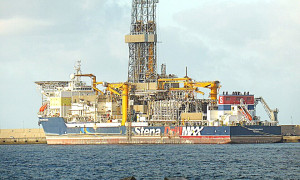
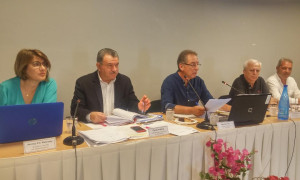
Ionian Islands Region recommends backing Asopos-1 drilling with 17 conditions
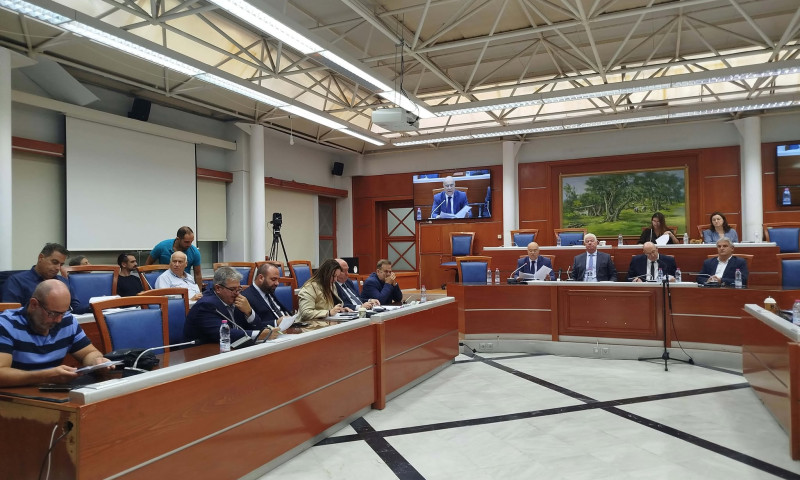 From the Regional Council meeting. Photo: Enimerosi
CORFU. The Ionian Islands Region’s Department of Environment has backed exploratory drilling in Block 2 of the Ionian Sea, but with a series of strict environmental and operational conditions. The final say rests with the Regional Council.
The Ionian Islands Region has backed the Asopos-1 exploratory drilling project in Block 2 of the northwestern Ionian Sea, subject to 17 specific conditions.
The opinion issued by the Department of Environment and Spatial Planning is included in the agenda papers for the Regional Council meeting, which is being asked to state its position on the project’s Environmental and Social Impact Assessment. This is an official recommendation by the relevant service, not yet a decision by the Regional Council.
The project involves an offshore exploratory well in waters approximately 840 metres deep, located 44.3 km west of Othoni and 60.1 km west-northwest of Cape Drastis. The location of the well is particularly significant, as it lies just 3.16 km from the maritime boundary between the Greek and Italian Exclusive Economic Zones (EEZs).
The Directorate explicitly concludes that it “gives a positive opinion” on the implementation of the project, provided that the additional conditions set out in its recommendation are met.
Among the most important conditions is that the work should, as a priority, be carried out during the first four months of the year, so as not to coincide with the peak tourist season. It also requires the floating drilling rig to remain at the site for no more than 90 days.
The Region is also calling for one of the support vessels stationed permanently alongside the drilling rig to be specially equipped to deal with oil pollution, including floating containment booms, pumping systems and the capacity to contain recovered hydrocarbons.
Particular emphasis is also placed on the protection of cetaceans. The Department calls for the exclusion zone during any potential VSP seismic survey to be increased from 500 metres to 1,000 metres, with the procedure required to stop if a sperm whale or other cetacean is detected in the area.
Memorandum of cooperation with Italy
One of the most distinctive conditions concerns the project’s cross-border dimension. Given the short distance from the Italian EEZ, the recommendation calls for an official operational coordination memorandum to be in place with the Italian Coast Guard and the Region of Apulia before drilling begins, allowing for an immediate joint response in the event of marine pollution.
An emergency response plan is also required, along with an active agreement guaranteeing the availability of a well capping stack and provision for a relief well in the event of a major accident.
The Department also makes the exclusive use of water-based drilling fluids a condition, while prohibiting the use or discharge of non-aqueous oil-based or synthetic-based muds.
At the same time, an independent environmental monitoring programme is proposed. This would begin before drilling, continue throughout the operation and include follow-up monitoring for up to 24 months after the well is abandoned.
Positive opinion from Epirus
The Region of Epirus has already issued a majority positive opinion on the same Environmental Impact Assessment, while the Municipality of Igoumenitsa has also adopted a decision on the project, as the port of Igoumenitsa is expected to be used as the logistical support base for the drilling operation.
The file is registered under PET number 2608016214 in the Electronic Environmental Registry, and the project falls into the highest environmental category, A1. Consequently, final responsibility for the environmental permitting process and the issuance of the Environmental Approval Decision (AEPO) lies with the Ministry of Environment and Energy’s Directorate for Environmental Licensing.
Today’s discussion at the Ionian Islands Region therefore carries particular political weight: the official recommendation is “yes, with conditions”; what remains to be seen is whether the Regional Council will adopt it, amend it or reject it.
GIORGOS KATSAITIS